
For the last two newsletters we have been building one idea together. Writing looks like a single act, but it is really four jobs happening at once, all drawing from the same small tank of effort. First the idea. Then the words. Then the details, the spelling and punctuation and letter order. Then the hand that forms it all on the line. When any one of those four costs too much, the others starve, and the page falls apart in a way that looks exactly like carelessness.
Last time I had you feel it in your own hand with a pencil. This time I am going to show you real children's pages, so you can see it with your own eyes.
Here is where these came from. There is a test called the Test of Written Language. For one part of it, every child, ages nine to seventeen, chooses a picture to write a story about, then works against the very same clock. Five minutes to plan, fifteen minutes to write. Twenty minutes, start to finish. The test offers more than one picture to choose from, and as it happened, all four of these children chose the same one, a scene of astronauts building a colony on the moon. So no child here had an easier or a harder prompt than the rest.
Then two scores come out of it. One for the mechanics (the test calls it contextual conventions), the spelling and punctuation and sentences. One for the story itself (formally, story construction), the vocabulary and the plot and whether it holds a reader. Ten is an average score, so you can read the numbers below against that.
Same picture. Same twenty minutes. Watch what comes back.
A fifteen-year-old boy.
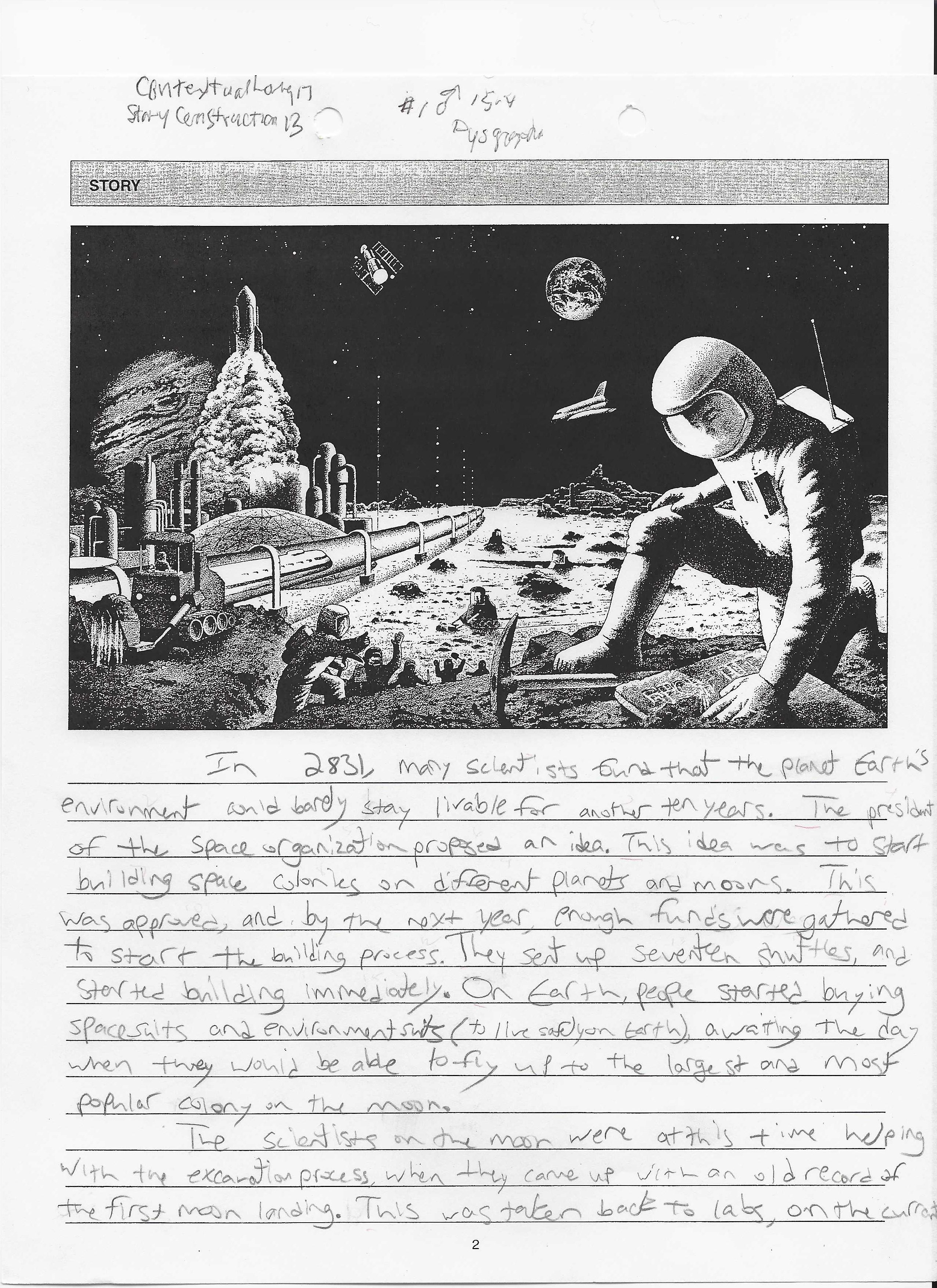
He opens like this. "In 2831, many scientists found that the planet Earth's environment would barely stay livable for another ten years." He keeps going for a page and a half. A space organization proposes colonies on other worlds, funds get raised, seventeen shuttles launch, and out on the moon a crew digs up an old record of the very first moon landing. Real plot. Real ideas. His mechanics score was seventeen and his story score was thirteen, both well above average. So the idea is strong. The words are strong.
Now look at the handwriting. Letters change size in the middle of a word. Some lean one way, then the next leans another. The spaces between words open up and close down, and here and there two words crash into each other. The two top parts of the machine, the idea and the words, are doing college-level work. The bottom part, the hand, is fighting him the whole way down the page. This is the child whose paper gets called messy while his mind is running laps around the assignment. Never read the penmanship as the intelligence.
An eight-year-old boy.
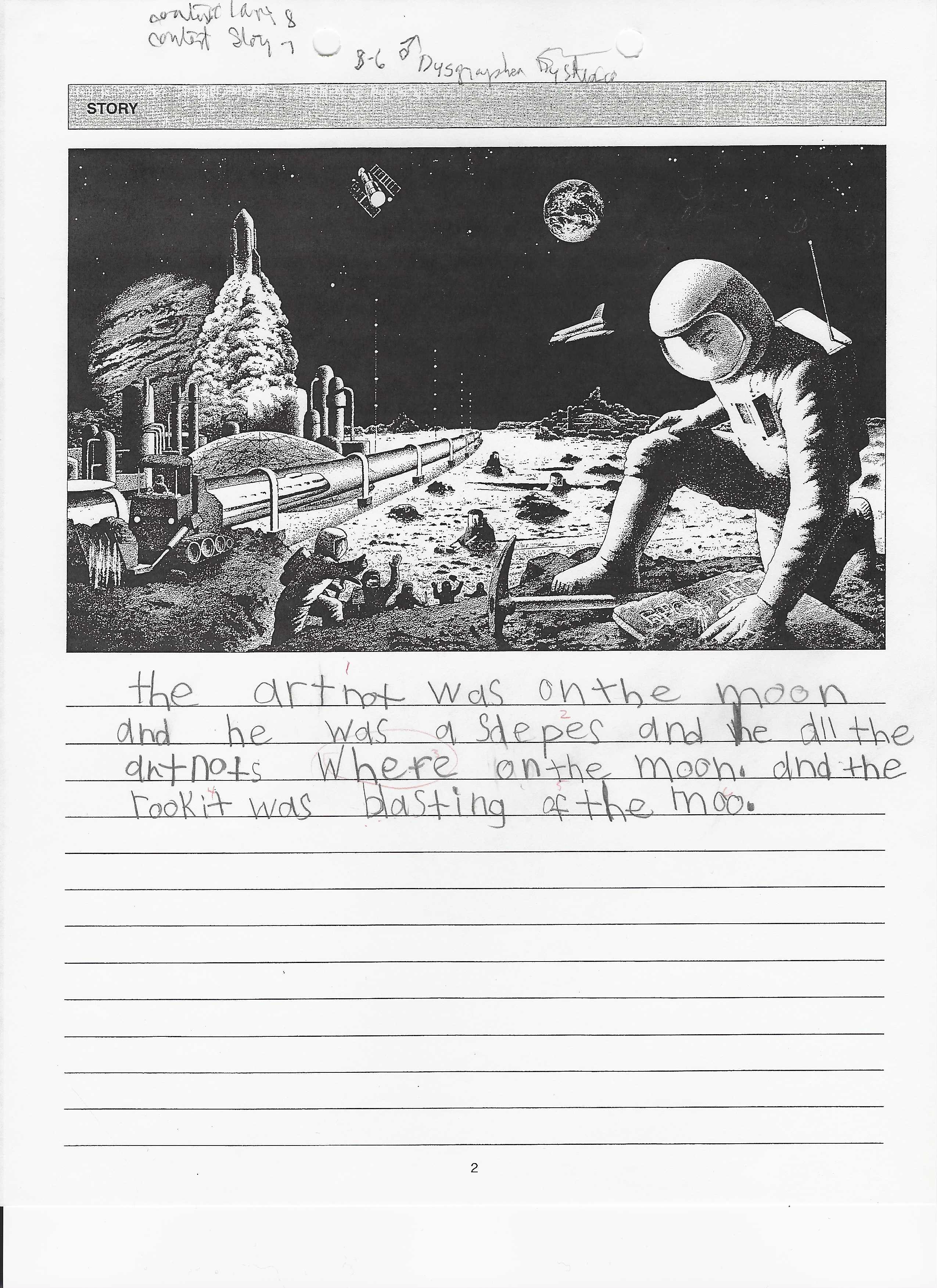
He is a touch younger than this test usually goes, and that matters, so hold it in mind. In the same twenty minutes, here is his whole story, and I am giving you every word of it. "the artnot was on the moon and he was a slepes and he dll the artnots where on the moon. and the rookit was blasting of the moo."
Astronaut came out "artnot." Rocket came out "rookit." Moon lost its n. He was not building a plot at all. He was naming what he saw in the picture and fighting for every letter of it. You can see the erasing and the writing over the top of words. Punctuation shows up exactly once, at the very end. Two sentences, against the first boy's page and a half, on the same clock. Now here is the part that surprises people. This test is standardized, which means each child is measured against others their own age, not against the fifteen-year-old you just met. His youth is already built into the number. His mechanics score came in at eight and his story score at seven, which lands him at the low end of average to just below it, for an eight-year-old. So this is not simply a young child being young. That seven would still read as low a year or two from now. When the words and the spelling both cost this much, there is nothing left in the tank to build a story on top. This is what "ran out of gas" looks like from the outside, and it is not a lack of trying.
A nine-year-old boy.
This is the one I want you to sit with. The year he wrote this, this boy had been attacked at school, and afterward he could not focus the way he used to, so the people around him had started to wonder if he had ADHD. On the surface he looked like a child with an attention problem and not much else.
He also had something called nonverbal learning disorder. It is a backwards-sounding name, because these children are often strong with words and very literal, and struggle instead with the nonverbal side of things, spacing, motor control, and reading the social signals the rest of us catch without thinking. That one label quietly explains two different things on this page. It may even be part of why he was attacked in the first place, since a child who takes everything literally can rub a classmate the wrong way without ever meaning to. It is also, as you are about to see, why his handwriting looks the way it does.
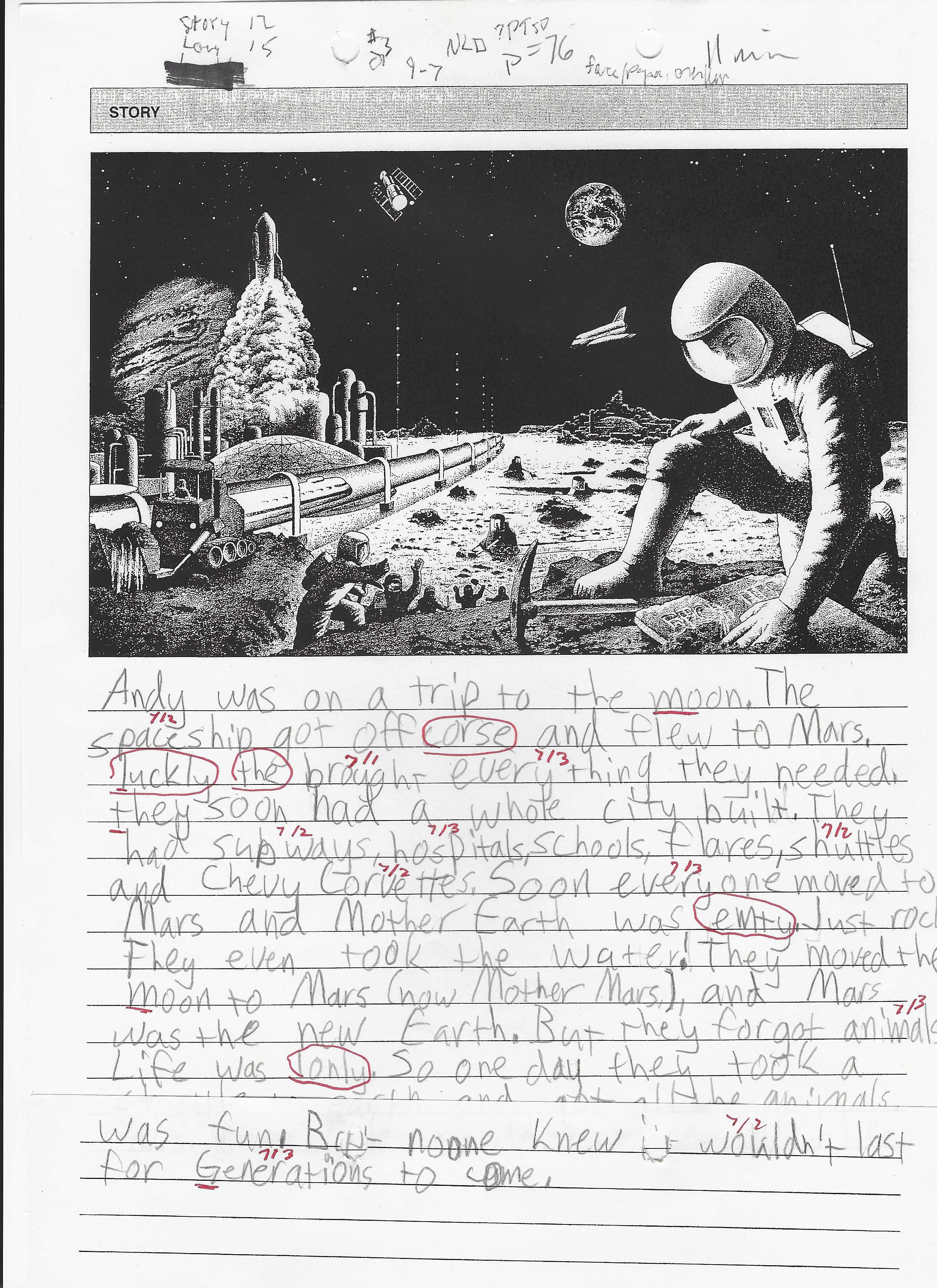
On paper, the attention worry is not what jumps out at you at all. His story is imaginative and it is organized. A spaceship gets knocked off course to Mars, a whole city goes up with "subways, hospitals, schools," and, my favorite touch, "Chevy Corvettes." Earth gets emptied out, the moon is towed over and renamed. His story score was twelve and his mechanics score was fifteen, both above average. Real plot, real voice, exactly the strength with words that so often rides along with this disorder.
Look closer, though, and the details wobble. "Corse" for course. "Emty" for empty. A capital dropped here, a slant that keeps shifting there, the spaces between words opening and closing. That is the other half of the same disorder, the spatial and motor half, landing right where you would expect it, in the hand and the fine details. The story is soaring while the spelling and the spacing scramble to keep up behind it. Here is the point I care about. If I had handed you this boy's history first, before you saw the page, you would not have pictured this story. The labels on a child do not predict what is on the paper. They only tell you where to look.
A thirteen-year-old girl.
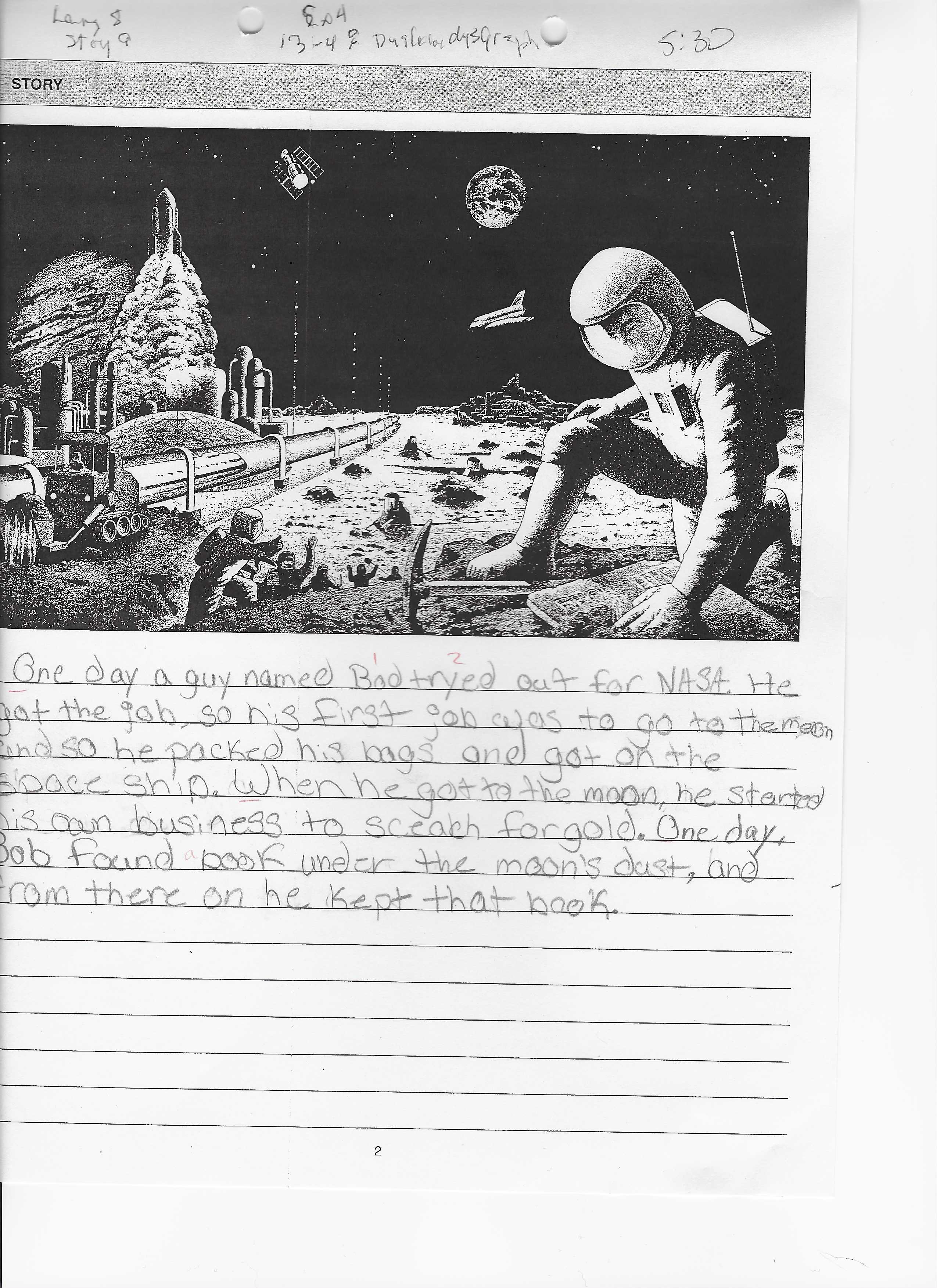
She is the mirror image of the first boy. Her handwriting is lovely. Even, rounded, easy to read. If we were grading this stack on neatness, she wins it.
So look past the neat letters to the words they spell. Her hero is named "Bod" in the first line and "Bob" by the last. "Tried" is written "tryed." "Search" comes out "sceach." "For gold" runs together into a single word. The trouble is right there in the spelling and the spacing, even while every letter is beautifully formed. Her story is short and stays on the surface. A man tries out for NASA, gets the job, flies to the moon, finds a book. Her mechanics score was eight and her story score was nine, both at the low end of average, the very same neighborhood as the eight-year-old two examples back, even though her page could not look more different from his. Here is the part that stayed with me. I watched her write, and she was working so hard to keep it neat that the neatness ate everything else. She spent her twenty minutes on legibility, and the story and the spelling are what paid for it. If you have been with me a few weeks, you will remember Sally, who could write neatly or finish on time but never both. This is Sally, a few years older, on a timed test. Neat is not the same as easy. Sometimes the tidiest page in the pile is the one that cost the most.
Here are all four, side by side.
| Child | What they carry | Mechanics | Story |
|---|---|---|---|
| Boy, 15 | Dysgraphia, nonverbal learning disorder | 17 | 13 |
| Boy, 8 | Dysgraphia, dyslexia | 8 | 7 |
| Boy, 9 | Nonverbal learning disorder | 15 | 12 |
| Girl, 13 | Dyslexia, dysgraphia | 8 | 9 |
Ten is an average score. Same picture, same twenty-minute clock. Four children who all struggled to get their story on the page, and scores that run from below average to well above it.
Read down the two number columns and a pattern steps forward. The two children with nonverbal learning disorder hold the highest story scores on the page, because that disorder tends to leave the words strong. The two children with dyslexia sit at the bottom, because dyslexia pulls on the words themselves. The label really can tell you where to look.
One more thing is worth noticing. Those same two boys with nonverbal learning disorder, whose handwriting looks the messiest of the four, scored the highest on mechanics. The test counts the spelling and punctuation a child gets right, not how the letters look on the line. What the number measures and what the page looks like are two different things.
Four children. One picture. One twenty-minute clock, exactly the same and exactly fair for every one of them. Four pages that look nothing alike.
Set them side by side and you can see the whole machine at once. The first boy's hand fighting a first-rate mind. The second boy out of gas after two sentences. The third boy's story outrunning his spelling. The girl's beautiful letters bought with everything else on the page. The idea, the words, the details, the hand. Every child jammed somewhere different, and not one of them was careless. Their scores spread from below average all the way up to well above it, and every one of them still struggled to fill a page. The score is not the child. It only shows how far the wiring has to stretch to do what looks, from the outside, like one simple thing.
That is what I most want you to carry away from these pages. When your child's writing comes home looking wrong, the page is not telling you who they are. It is telling you which part of the job cost them too much. Your work, and mine, is to find that part and take some weight off it, so the child you already know is in there can finally reach the paper.
So here is my question for you. Picture the last thing your child wrote that made you wince. Now look at it as a machine with four parts, the idea, the words, the details, the hand. Which part do you think was carrying too much?
Hit reply and tell me. I read every one.
Next time we turn to the reading side of all of this, dyslexia, which was sitting quietly inside two of the pages you just saw.
Warmly,
Dr. Pat
Patricia McGuire, MD, FAAP
Developmental-Behavioral Pediatrician
P.S. If these four pages made you want to look twice before you trust a label, that is the whole idea behind the book I would hand you next, Never Assume: Getting to Know Children Before Labeling Them.
P.P.S. Something free, if it fits your house.
Several of you have written to me about a daughter who holds it together all day at school and comes apart the moment she gets through the front door. If that sounds familiar, I made a short checklist of seven quiet signs of ADHD in girls, the ones that get missed because she is not the child bouncing off the walls.
It costs nothing and it downloads the moment you ask for it. No account to set up.
https://www.helpingchallengingchildren.online/adhd-in-girls-checklist





Responses