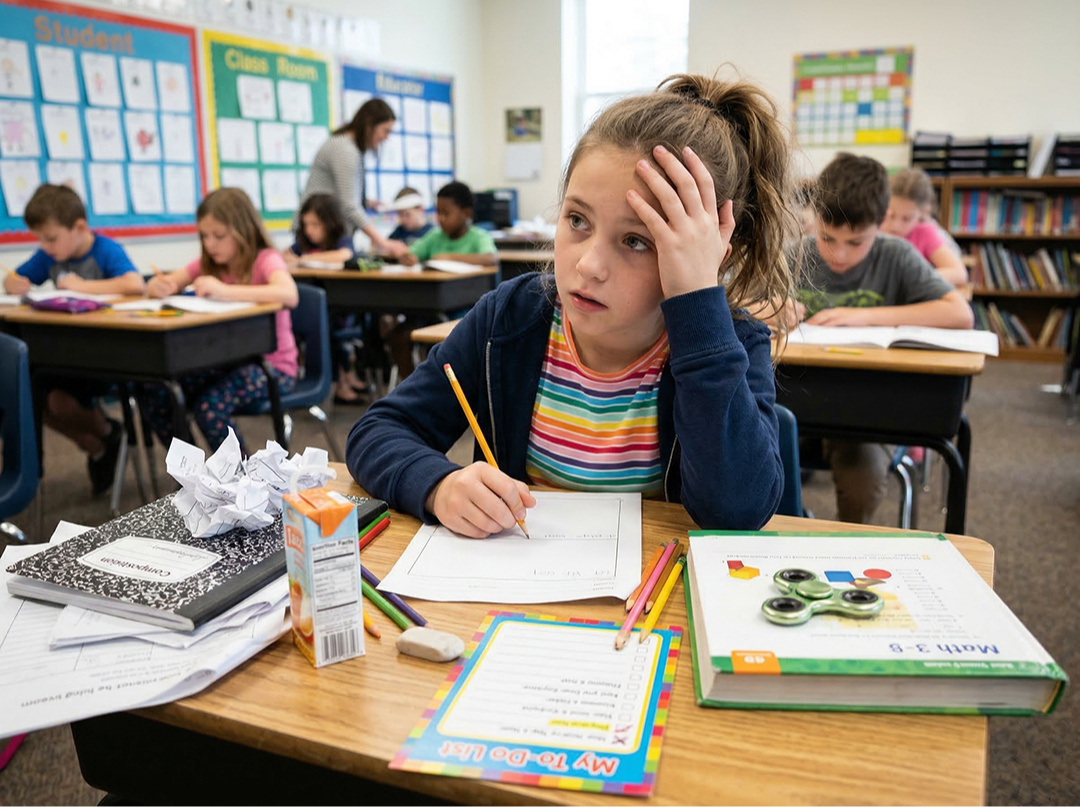
Does Your Daughter Seem “Fine” at School
But Struggles Silently at Home?
A Story-Based Guide From a Developmental-Behavioral Specialist with over 30 years experience working with girls with ADHD.
Discover How To Finally Understand Why Your Bright Daughter Can’t Remember Simple Instructions — And Help Her Thrive
(even if teachers keep saying “she’s just daydreaming” or “she needs to try harder”)
If you’ve ever watched your daughter forget her homework again, lose her jacket for the third time this week, or sit at the kitchen table for two hours trying to finish 15 minutes of math…
…while her siblings breeze through their work…
…and wondered why such a bright, creative girl struggles with things that seem so simple…
You’re not alone. And more importantly — it’s not her fault.
Your Daughter Might Be Experiencing:
- Losing things constantly — jackets, homework, lunch boxes, the thread of what she was doing
- “Space cadet” comments from teachers who don’t realize she’s actually trying her absolute hardest to pay attention
- Two-hour homework battles that end in tears for both of you — even though you can see she clearly understands the concepts
- Social struggles as friends start drifting away because she seems “too much” or forgets plans entirely
- Growing self-doubt as she internalizes messages that she’s “lazy,” “careless,” or “not living up to her potential”
- Teachers saying she’s capable but “not working to her potential” — a phrase that hides far more than it reveals
And the worst part? Every failed solution makes her believe a little more that she’s fundamentally flawed.

What the Research — and 30 Years of Clinical Work — Reveals
After more than three decades working with children who think differently, I kept seeing the same heartbreaking pattern: bright, creative girls arriving in my office only after years of unexplained struggle. By the time families found me, their daughters’ confidence was already in ruins.
The answer, far too often, was inattentive ADHD — a condition that had been hiding in plain sight for years.
Here’s what the research shows:
- Girls with ADHD are diagnosed 2 to 3 times less often than boys in childhood — yet by adulthood the ratio is nearly equal. They had it all along. They were simply missed.
- Girls present differently — they’re not bouncing off walls, they’re lost in their thoughts, appearing “spacey” when they’re actually experiencing real attentional deficits
- Teachers and parents consistently underestimate symptoms in girls — we expect girls to be naturally organized and compliant
- Inattentive presentation gets missed — especially in bright girls who can still pass their classes… until they can’t anymore
- By the middle school years , untreated ADHD creates secondary anxiety and depression — the shame of “failing” at basic life skills deeply damages their self-image
Most parents of girls with inattentive ADHD are unknowingly waiting too long — convinced their daughter just needs to “mature” or “apply herself better.” Every year without identification adds another layer of damage.

Introducing
“The Girl Who Couldn’t Sit Still Inside”
A Story-Based Guide for Parents of Daughters with Unrecognized ADHD
I wrote this guide as a story — because stories reach us in ways that clinical explanations cannot. When a parent reads a checklist of symptoms, they may or may not see their daughter. But when they read about a girl who loses her homework for the third time that week, who sits staring at a math test she studied for but cannot remember, who watches her friend drift away because she keeps forgetting plans — that’s when recognition hits.
That’s the moment a parent thinks: That’s my child.
This is the ADHD book the market has long needed—an extended, inside look at how ADHD presents in girls and why it so often goes unrecognized by parents and teachers.
By following Sara and her family over several years, readers gain a clear understanding of the real impact of undiagnosed ADHD: the growing gap between effort and outcome, the confusion at home and school, and the quiet toll on a girl’s confidence.
Written in a story-driven style that feels almost like a play, the book brings an immediacy to each moment, allowing readers to see and feel what is often missed.
Grounded in both professional and personal experience—as a pediatrician, a parent of children with ADHD, and someone with ADHD herself—the author offers a perspective that is both credible and deeply informed.
Cynthia Hammer, MSW
Author of Living with Inattentive ADHD
Executive Director, Inattentive ADHD Coalition
By Following Sarah Shaw’s Story, You’ll Be Able To:
- Recognize the subtle signs of inattentive ADHD that teachers and doctors routinely miss in girls
- Understand why “trying harder” doesn’t work when the brain’s executive functions aren’t developing typically
- Navigate the evaluation and support process without the years of runaround that cost so many families precious time
- Advocate effectively for your daughter in school meetings and medical appointments
- Support her self-esteem even while she’s struggling — so she doesn’t spend years believing she’s “less than”
- See that there are no villains in this story — only well-meaning people who simply didn’t know what to look for
The 4 Essential Recognition Skills Every Parent Needs
(That Schools Often Don’t Provide)
|
SKILL 1: Recognizing Inattentive Presentation Understanding the difference between hyperactive ADHD and inattentive ADHD — because while boys might be climbing the walls, girls are often lost in their heads. They appear “spacey” or “daydreaming” when they’re actually experiencing real attentional deficits that interfere with learning and daily functioning. Without this skill: Your daughter will continue being told to “pay better attention” while her working memory deficits go unaddressed. |
|
SKILL 2: Identifying Executive Function Deficits Learning to recognize when disorganization is neurological, not behavioral — because losing homework, forgetting multi-step instructions, and having no sense of time aren’t character flaws. They’re symptoms of underdeveloped executive function. Without this skill: You’ll keep trying behavioral interventions for a neurological problem, wondering why nothing works. |
|
SKILL 3: Understanding Gender Bias in ADHD Recognition Recognizing how socialization causes girls to mask their struggles — because girls learn early to “camouflage,” appearing to manage better than they actually are. This leads to delayed identification and years of unnecessary suffering. Without this skill: You’ll accept surface-level functioning while she burns out trying to appear “normal” every single day. |
|
SKILL 4: Navigating the Evaluation System Knowing when and how to request comprehensive evaluation — because understanding the school-based support process, what a comprehensive evaluation actually includes, and how to advocate effectively for appropriate services can mean the difference between struggle and success. Without this skill: You’ll waste precious years while she falls further behind — emotionally and academically. |
The Transformation You Can Expect
Before The Guide
- Constant frustration wondering why your bright child can’t do “simple” things
- Feeling like you’re failing as a parent because nothing you try helps
- Watching her self-esteem erode as she internalizes “lazy” and “careless” labels
- Homework battles that last hours and end in tears
Fear that she’s falling behind with no idea how to help
After The Guide
- Clear understanding of what’s actually happening in her brain
- Confidence to advocate effectively for evaluation and appropriate support
- Tools to help her succeed while protecting her self-image and confidence
- Ability to explain her struggles in ways that schools understand and respond to
Hope that early recognition will change her entire life trajectory
Your Recognition Path Begins Here
Each part of Sarah’s story is precisely designed to show you what ADHD in girls actually looks like — through authentic, lived experience grounded in decades of clinical observation.
PART 1: Elementary Years (Sarah’s Story — Ages 7–11)See the early signs that everyone missed — including why well-meaning teachers, caring parents, and attentive pediatricians still didn’t recognize what was right in front of them. • The specific behaviors that teachers dismiss as “just being a girl” • How working memory deficits show up in everyday tasks at home and school • The moment parents realize “trying harder” isn’t working — and what to do next |
PART 2: Middle School Crisis (Sarah’s Story — Ages 11–14)Understand why the middle school transition makes everything harder — and how the cascade of secondary symptoms develops when ADHD goes unrecognized. • How increased academic demands intensify inattentive ADHD symptoms • The development of anxiety and depression from years of perceived “failure” • What a proper evaluation includes and how to navigate requesting one |
PART 3: High School Success (Sarah’s Story — Ages 14+)Discover what properly supported ADHD looks like — Sarah’s transformation shows you what becomes possible when a girl finally gets the recognition and support she deserved all along. • How appropriate support helps the brain work better and confidence return • The role of therapy and other interventions alongside academic accommodations • Building self-advocacy skills that carry her into college and adulthood |